

Your Amazon account gets suspended, and the first thing most sellers do is panic. The second thing they do is Google a template, or worse, paste the suspension notice into ChatGPT and copy whatever comes out. Then the Amazon reinstatement appeal gets rejected. Then a second one gets rejected too. And now the account has a rejection history that makes the next Amazon reinstatement even harder to win.
What nobody tells you in that moment is that the problem was never that AI got involved. The problem is almost always how it got used. There's a real difference between asking a chatbot to write your excuse and using AI tools for Amazon sellers to actually figure out what broke in your account. This blog is about where AI genuinely helps an Amazon reinstatement appeal, and where a real person still has to take over.
Why Is Getting Reinstated on Amazon Harder in 2026?
Amazon increasingly relies on automated systems and data-driven enforcement to identify potential policy and performance issues. This means it catches things faster and gives sellers less room to explain themselves after the fact. A suspension used to come after a human reviewer looked at a pattern over weeks. Now it can trigger the moment an automated system flags a metric, a complaint, or an account link. The same speed that works against you in enforcement can work for you in the appeal, but only if you move correctly.
Here's what's actually at stake in dollar terms. Take a seller doing $5M a year. A 72-hour suspension on that account costs roughly $41,000 in gross revenue, just from the account sitting dark for three days. That's before you count the ranking loss, the ad spend needed to recover position, and the Buy Box share a competitor picks up while you're offline.
Because enforcement is automated now, the bar for what counts as a credible Amazon reinstatement appeal has gone up, not down. A vague, generic, or emotional POA gets rejected faster than it would have two years ago. Amazon isn't reading these appeals for tone anymore. It's checking whether the person on the other end actually understood what went wrong.
What Does a Strong Amazon Reinstatement Appeal Actually Require?
A strong appeal letter for reinstatement requires three things done correctly: the real root cause, the corrective actions you've already taken, and the preventive steps that stop it from happening again. Most sellers know this structure exists. Very few actually execute it well.
The mistake is treating an Amazon Plan of Action like a persuasive essay. It isn't one. It's closer to a compliance document. Amazon isn't asking, "does this person feel bad about it?" Amazon is asking three specific questions:
- Did you correctly identify what actually triggered the suspension? Not what the notice says on the surface. What actually happened operationally.
- Have you already fixed it, with something concrete to show for it? A promise to "be more careful" isn't a fix. A new inspection step, a supplier change, and a documented process are.
- Will this specific failure happen again? This section needs to tie directly back to the root cause you named, not read like a generic safety pledge copied from another appeal letter for reinstatement.
This is where the gap between what Amazon wants and what most sellers submit becomes obvious. Reviewers evaluate a high volume of appeals, so vague or generic submissions are unlikely to stand out for the right reasons. A weak or vague POA is the single most common reason an appeal gets denied, and that weakness almost always traces back to one thing: the seller never correctly figured out what actually went wrong in the first place.
How Does AI Help Identify the Suspension Root Cause?
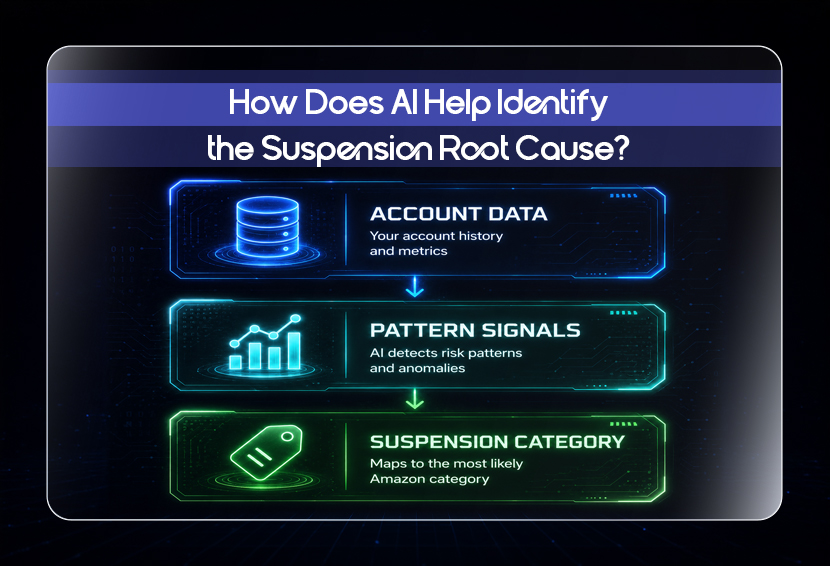
This is where AI root cause analysis for seller appeals actually earns its place in a reinstatement strategy. Misidentifying the trigger is the number one reason appeals get rejected on the very first submission. It is not a bad writing style or lack of effort but a wrong diagnosis.
The reason sellers get this wrong so often is simple: the suspension notice Amazon sends you is a symptom, not the actual cause. An "inauthentic complaint" might really trace back to a supplier switch six weeks earlier. A performance suspension for order defect rate might really be one fulfillment partner shipping late during a demand spike. Reading through months of Seller Central data by hand, trying to spot which metric moved first and why, is exactly the kind of repetitive manual work a person tends to miss, and an AI system is built for.
Here's what using AI to fix an Amazon account suspension looks like in practice:
- Account data: feeding in account health data, ASIN-level flags, and order history so the system can cross-reference what actually changed before the suspension hit, instead of guessing.
- Pattern signals: checking whether ODR crept up two weeks before the notice, whether a specific ASIN got multiple authenticity complaints, or whether there's a related-account flag tied to a shared IP or payment method.
- Suspension category: narrowing down whether you're dealing with ODR, authenticity, related account, or a straight policy violation, since each one needs a completely different POA, and treating them the same is how appeals fail.
This is exactly the gap our AI-powered Reinstatement Estimator is built to close. Instead of a seller manually digging through dashboards trying to piece together what happened, the tool analyzes the suspension details against Amazon's own policy categories and historical case outcomes and returns a viability score along with the most likely root cause driving it. Cases that come back complex or high-risk get flagged for a person to step in immediately, because there's a hard line between what AI should analyze and what still needs a human decision.
Can I Use AI to Write My Amazon POA?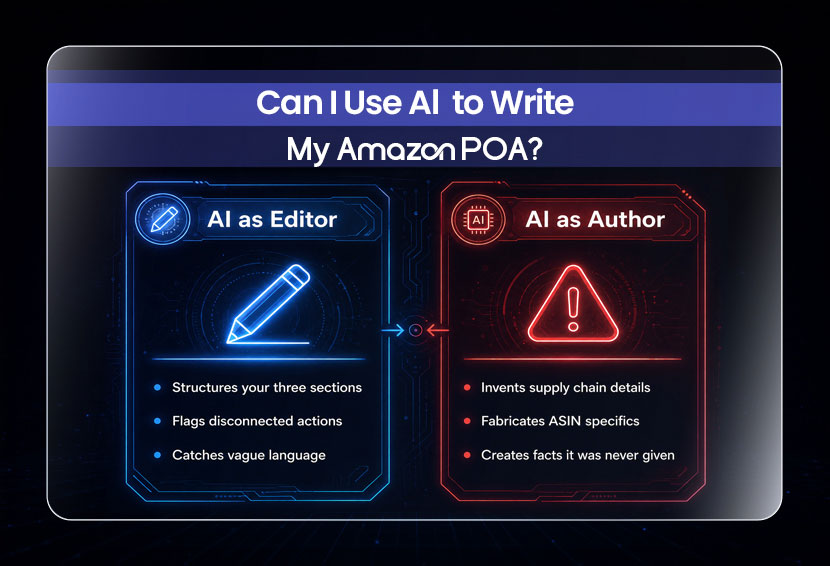
Yes and no, and the difference between the two matters more than almost anything else in this whole process. If you mean pasting a suspension notice into a chatbot and copying whatever it spits back into Seller Central, no. That gets rejected, and it usually gets rejected fast, because generic AI appeal letter output reads exactly like what it is: a template with no account-specific facts in it. Amazon's reviewers see hundreds of these a day. A rejection often happens because Amazon doesn't believe the seller actually understood what went wrong, and a copy-pasted AI response is the clearest possible signal of that.
But if you mean using AI to organize and structure the appeal once you already know the real root cause, that's a completely different use case, and a legitimate one. Here's the line:
- AI as an editor and organizer: structuring your three sections cleanly, flagging places where your corrective actions don't actually connect back to your stated root cause, catching vague language before you submit it.
- AI as the author of facts it doesn't have: inventing specifics about your supply chain, your inventory process, or your customer complaints that it was never given. This is where things fall apart, because Amazon checks the details against your account data, and fabricated specifics don't hold up.
AI can help you say what you already know more clearly. It can't know things about your business that you never told it. Every date, every ASIN number, and every corrective step still has to come from you and get verified before it goes in. Skip that step, and you're just submitting a well-formatted guess. AI-driven Amazon Plan of Action templates only work when the inputs are real.
Will Amazon Reject an AI-Written Appeal?
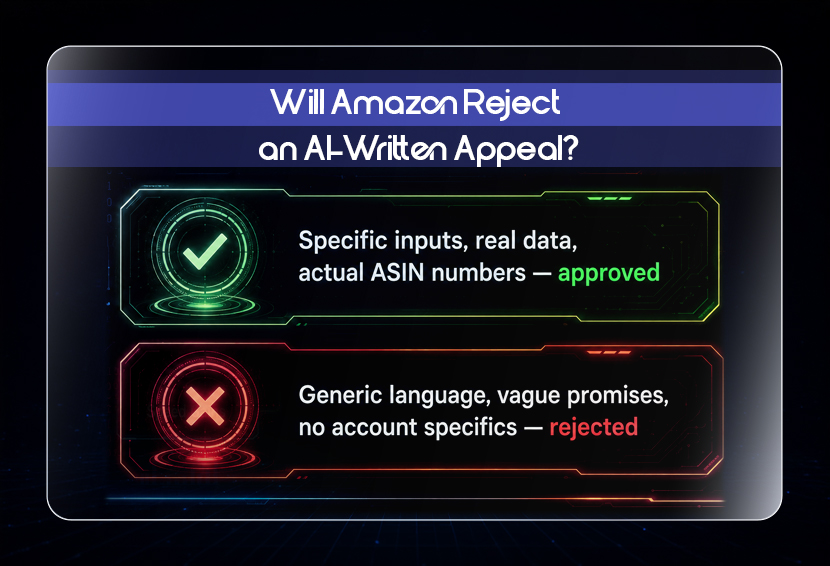
No, not because of the tool used to write it. Amazon's published appeal guidance focuses on the substance of the submission, such as the root cause, corrective actions, preventive measures, and supporting documentation, rather than how the text was drafted.
A generic AI output usually fails on all three of those, which is exactly why AI-written appeals get a bad reputation. But a POA that was drafted with AI assistance and still contains real ASIN numbers, real dates, documented corrective actions, and attached evidence has just as much chance as one typed out entirely by hand. The tool doesn't matter to Amazon's review team. The content does.
If your appeal letter for reinstatement reads like it could apply to any seller with any suspension, it fails, whether a person or an AI wrote the sentences. If it reads as if it could only be about your account, your ASIN, your specific fix, it has a real shot.
Conclusion
AI doesn't write your reinstatement for you, and anyone telling you it can is setting you up for another rejection. What it actually does is help you see what is buried in your own account data faster than you would find it manually going through Seller Central, and it helps you organise that into something a reviewer can act on.
To get reinstated, you don't need to submit the longest, most polished-sounding POA. You need to diagnose the real problem correctly on the first try, then back it up with specifics a reviewer could actually verify. If you're not sure your root cause is right, that's the thing to fix before you write another word of the appeal itself.
FAQs
Q: Is Amazon reinstatement possible after multiple rejections?
Yes, but each rejection makes the next appeal harder, since a rejection history signals to reviewers that previous root cause explanations didn't hold up. The key is not resubmitting a reworded version of the same appeal. Go back through Amazon's rejection feedback line by line and treat it as a checklist of what's still missing, then rebuild the root cause section from scratch if needed.
Q: How long does Amazon take to review a reinstatement appeal?
Most sellers see an initial response within a few days, though timelines stretch when Amazon requests additional documents, flags the category as high-risk, or when you're on a second or third round of appeals. Complex cases involving Section 3 suspensions or counterfeit claims often take longer.
Q: What documents should I attach to my Amazon appeal?
Only documents that directly support your root cause and corrective actions. Supplier invoices, authenticity letters, compliance certificates, or internal process documentation all help when they're tied to the specific issue Amazon flagged. Attaching unrelated paperwork just to look thorough usually slows the review down instead of helping it.
Q: What are the best AI tools for Amazon sellers dealing with suspensions?
Look for tools built specifically around Amazon's suspension categories and policy data, not general-purpose writing assistants. A tool like our Reinstatement Estimator is built around Amazon-specific suspension codes and historical outcomes, which is a very different job than asking a general chatbot to guess what might have gone wrong.
Weekly Newsletter
Scale Without Operational Chaos
Get weekly actionable insights and AI updates to improve operations and grow with better systems.
2,400+ operators subscribed
Unsubscribe anytime