

AI shopping agents are changing how customers discover and buy products online. Anthropic's Claude Commerce Agents introduce a new approach where AI can help shoppers find products, compare options, and interact with online stores.
Before making assumptions about what this means for sellers, it helps to know exactly what this is, what it does, and whether it actually changes anything for your store right now. This blog breaks it down in plain terms.
What Is a Claude Agent?
A Claude agent is Claude set up to do a job on its own, step by step, instead of just answering one question at a time. Instead of you typing a question and getting one reply, an agent can search for information, make a decision, take an action, and check its own work, all without you guiding every single step.
Claude Commerce Agents is Anthropic's name for a specific version of this built for online selling. Anthropic released Claude Commerce Agents as an open-source blueprint, and it is not an app you download or a feature you switch on inside your Amazon or Shopify account. It is a blueprint, meaning a set of building blocks that an engineering team uses to build a shopping assistant or a store-management assistant from scratch, connected to a specific store's own systems.
The package includes two separate tools:
- A shopping agent that customers talk to while browsing a store
- A merchant agent that store staff use to manage the business behind the scenes
It also comes with working demo versions for retail, travel, telecom, and event ticketing, plus a Claude Code plugin that helps developers set one up faster. None of this connects automatically to any store. Someone still has to build the connection to your actual catalog, cart, and checkout. 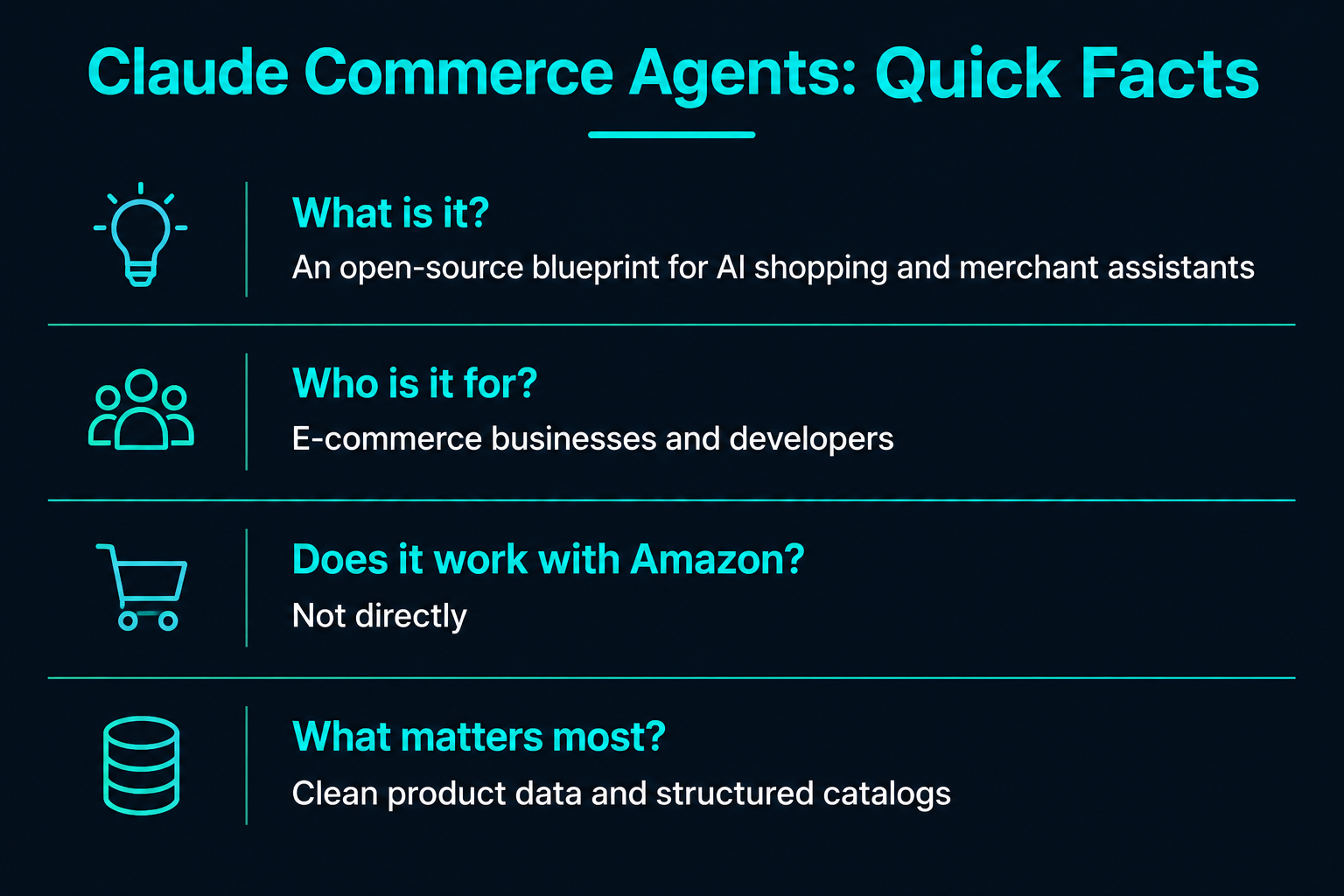
What Can the Shopping Agent Do For Your Customers?
The shopping agent sits inside a store's own website or app and talks with customers directly. A shopper can type something like "I need a tent, sleeping bag, and stove for a weekend trip with two kids," and the agent searches the catalog, recommends relevant combinations, and can build a cart instead of making the shopper search three separate product categories.
Here is what it's built to handle:
- Multi-item requests: finding several related products for one need, not just one search term.
- Remembering preferences: using what it already knows about a returning customer to suggest better matches.
- Comparisons inside the chat: showing products and prices side by side in the conversation itself.
- Handing off to checkout: building the cart, then passing it to the store's own payment system.
- Answering order questions: where a package is, how to return something, what the refund policy says.
The agent does not process payment itself. It builds the cart and steps back once checkout begins.
What Can the Merchant Agent Do For Your Store?
The second half of the blueprint is built for the people running the store, not the customers. A staff member can ask something like "what should we discount to clear last season's inventory," and the merchant agent answers using the store's own sales data.
It's designed to:
- Explain what's selling well and what isn't
- Flag inventory problems before they become a real issue, like a product about to sell out mid-promotion
- Suggest pricing and promotion ideas based on available store data
- Draft marketing campaigns for products that need to move
The one detail worth remembering here is that every change the merchant agent suggests has to be approved by a person before it goes live. It does not update your prices or launch a campaign on its own.
How Does Claude Keep Agents From Making Costly Mistakes?
This is probably the most important part for anyone worried about handing a chatbot access to their store. Anthropic built specific limits directly into the code, not just as instructions Claude is told to follow.
A few of the actual guardrails:
- The architecture is designed so payment details and checkout handling remain outside the agent's control.
- A cart can only ever contain product IDs that came back from the store's own system, so the agent cannot invent a product or a price that does not exist in the catalog.
- Every piece of information coming from the store's backend is filtered before the agent sees it, as a defense against hidden instructions planted in product listings.
- Merchant-side changes sit in a queue for human approval before anything reaches a customer.
This matters because the risk with any AI agent handling money or inventory is not that it misunderstands a request. It's that it acts on a bad instruction without anyone checking first. Anthropic built the system so the code itself, not the model's judgment, decides what the agent is allowed to touch.
Why Does Your Product Data Decide Whether this Works For You?
A code review by e-commerce data specialist CommerceClarity found that the shopping agent can only apply a condition a customer mentions, like "waterproof" or "under two kilograms," if that detail already exists as a clean, structured field in your product data. If the fact only lives inside a paragraph of product description, the agent cannot reliably use it as a filter.
The review found a specific limitation in Anthropic's demo catalog. A product listed weight capacity as "700 lb," but a shopper searching for "700 lbs" did not receive an exact match because the values were formatted differently. When a filter fails to match, the reference code drops it quietly and shows a broader list of related items instead of telling the shopper the exact product could not be confirmed.
For your store, this means three things matter more than ever:
- Every attribute a customer might ask about needs its own field: size, material, weight, compatibility, whatever applies to your products
- Values need to be written the same way across your whole catalog: one unit, one format, not "2 lb" on one listing and "2 lbs" on another.
- Facts buried only in your description text are invisible to a search filter, even though a human reading the page can see them fine.
Messy, inconsistent product data can already make search visibility and conversion optimization harder. It just becomes the deciding factor now, not a minor inconvenience.
How Can You Actually Use Claude Agents Without a Dev Team?
Claude Commerce Agents is not something you install into an existing Amazon, Walmart, or Shopify store this week. It requires a development team to connect it to your specific systems, and Anthropic has said plainly that it will not maintain this as a supported product going forward.
That said, there is a realistic path forward if you run a smaller store:
- Start with your catalog, not the agent: Clean, consistent product data helps you today, whether or not you ever touch an AI agent. This is the same discipline behind good business process automation , fixing the underlying process before adding a new tool on top of it.
- Watch what your existing platform does: Shopify has already published its own version connected to live stores through its own commerce protocol. If you sell on Shopify, a version of this may reach your store through a platform update rather than custom development.
- Weigh the cost against what you'd actually gain: Building a custom agent from this blueprint means ongoing engineering time, not a one-time setup fee. For most individual sellers, waiting for a platform-level rollout will cost less than commissioning custom work, unless the volume of your store already justifies it.
- If you do decide to invest: treat it the way you'd treat any other automation project: start with one narrow, low-risk task, like a read-only sales summary, before giving an agent any ability to change live listings.
Are the Reported Cart and Conversion Gains Reliable?
Anthropic's launch announcement states that retailers running shopping agents on Claude have seen carts up to 35% larger and shoppers 60% more likely to complete a purchase. Those numbers sound significant, so it's worth knowing where they come from before you factor them into any decision.
According to PYMNTS , those are Anthropic's own reported figures rather than an independently verified benchmark. A separate report from PaymentsJournal states the 30% to 35% cart increase came from a single retail partner, not an average across many stores. Treat the numbers as a best-case example from one company's experience, not a guarantee of what any given store will see.
How Do Claude Commerce Agents Compare to Traditional Ecommerce Search?
Traditional ecommerce search relies on keywords. A shopper types a product name, applies filters, and scrolls through results based on matching terms. This works well for specific searches, but it often struggles when customers describe a need instead of a product.
AI shopping assistants change this by understanding context and intent. Instead of searching for individual products, shoppers can explain what they need, compare options, and receive recommendations through a conversation.
For example, a traditional search might require a customer to search separately for “camping tent,” “sleeping bag,” and “camp stove.” A conversational commerce experience can understand that the customer is planning a family camping trip and suggest a complete set of relevant products together. 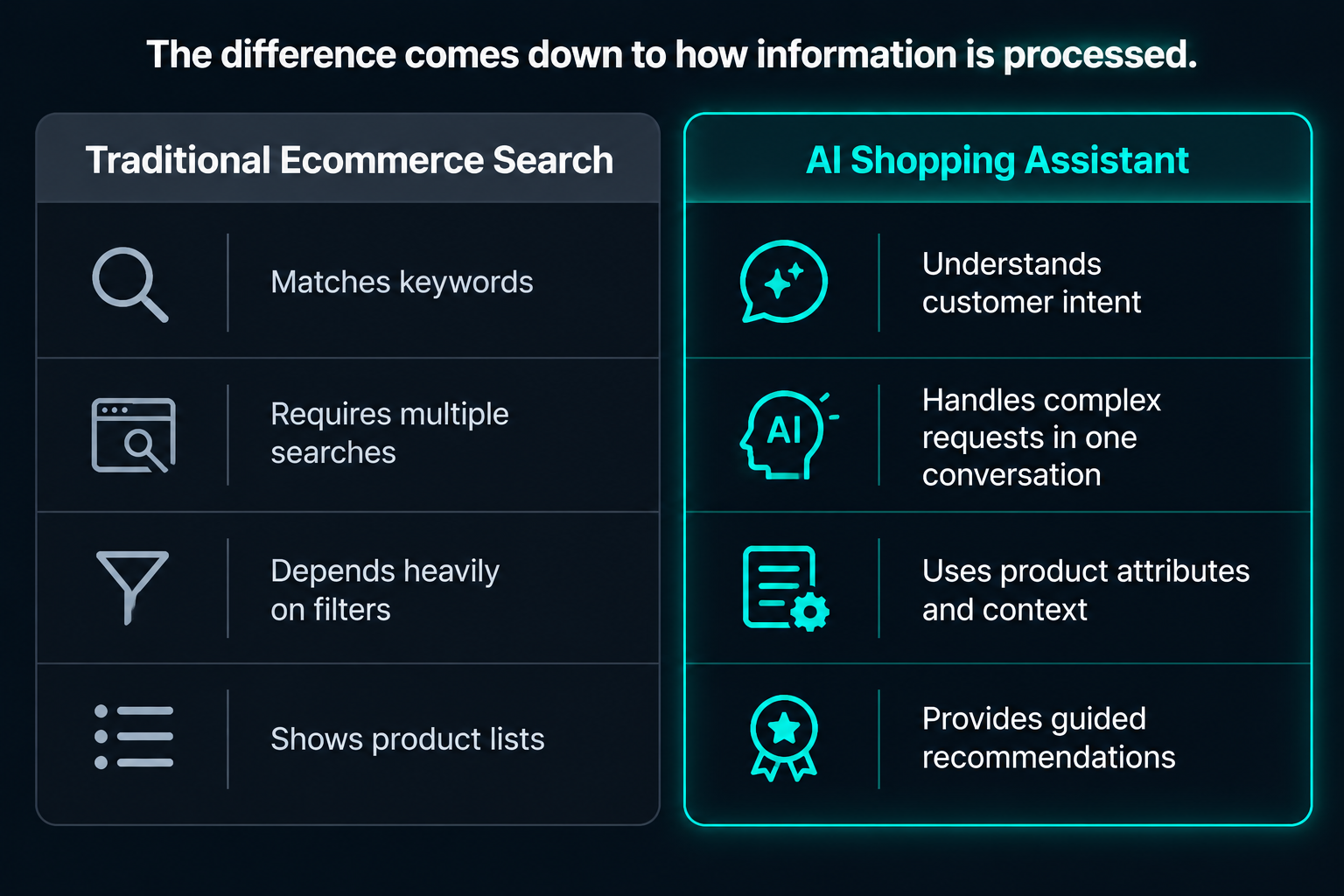
However, AI search is only as effective as the product data behind it. If product attributes, specifications, and inventory information are incomplete or inconsistent, even advanced AI systems will struggle to provide accurate recommendations.
For sellers, this means ecommerce success will increasingly depend on structured product data, optimized listings, and organized catalogs. The same foundations that improve visibility and conversions today.
Conclusion
Claude Commerce Agents show where ecommerce is heading: shopping experiences will become more conversational, personalized, and dependent on accurate product data. While most sellers cannot build custom AI agents today, they can prepare for this shift by improving the foundation these systems rely on, such as clean catalogs, structured product information, efficient workflows, and reliable store operations.
The brands that benefit most from AI-driven commerce will not be the ones that simply adopt new tools first. They will be the ones with organized systems and high-quality data already in place. Optimized listings, accurate product attributes, and streamlined operations will continue to drive better visibility and conversions across marketplaces and ecommerce platforms.
SPCTEK.AI helps ecommerce brands build these foundations through AI-powered solutions, marketplace optimization, and operational systems designed to make businesses more efficient and ready for the future of commerce. 
FAQs
Q: Is Claude Commerce Agents free to use?
The code is released under an open-source license, so there is no fee to access it. Running it still costs money for Claude API usage, plus whatever it costs to hire a developer to build and connect it to your store.
Q: Can the agent complete a purchase without a human involved?
No. The shopping agent builds the cart and hands it to the store's existing checkout system. It never processes payment itself, and no order in the demo versions charges a card.
Q: Do I need to be a developer to use it?
To build a custom agent from this blueprint, yes. As a shopper or a store owner, you would encounter this through a platform that has already built it in, such as a future Shopify or Amazon feature, rather than setting it up yourself from the raw code.
Q: Does this work with Amazon, Walmart, or Etsy stores?
Not directly. The blueprint ships with reference examples for retail, travel, telecom, and ticketing built on a fictional demo store, and Shopify is the only major platform that has published its own connected version so far. A seller on Amazon, Walmart, or Etsy would need a developer to build a custom connection, since none of those marketplaces have announced a built-in version of this yet.
Q: Will this replace the need for good SEO or listing optimization?
No. If anything, it raises the bar. The shopping agent finds and filters products using the same kind of structured, well-organized data that good SEO and listing practices already call for. A poorly optimized listing is just as invisible to a shopping agent as it is to a regular search bar.
Weekly Newsletter
Scale Without Operational Chaos
Get weekly actionable insights and AI updates to improve operations and grow with better systems.
2,400+ operators subscribed
Unsubscribe anytime