

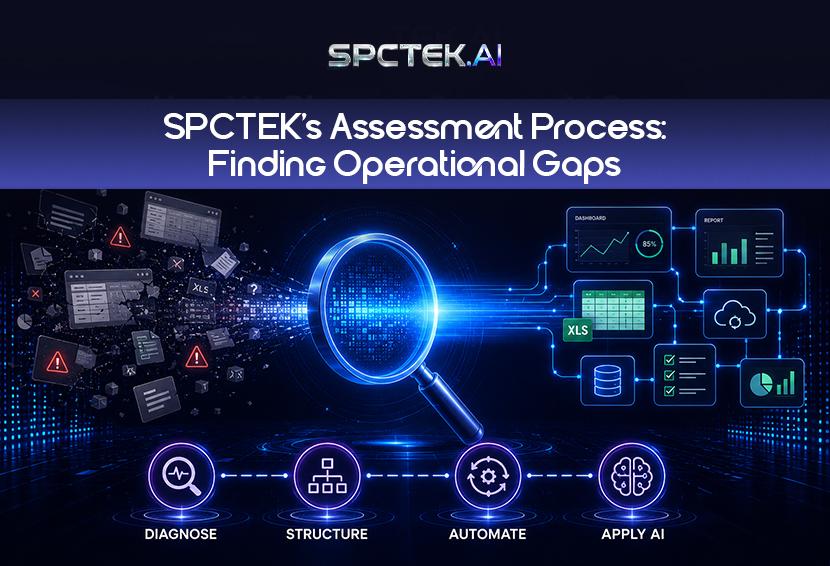
Most businesses that reach out to SPCTEK think they're ready for automation. They've heard about AI workflows, connected dashboards, and systems that run without constant oversight. What they actually need first and rarely realize is a clear picture of what's broken and where. Automation layered on top of a broken process doesn't fix anything. It speeds up the damage.
This is why every engagement at SPCTEK starts with a business process assessment, not a solution. Before any tool gets recommended or any workflow gets built, the real question has to be answered: where exactly is the business leaking time, money, and capacity, and why?
What Is an Operational Gap Assessment and Why Does It Come Before Automation?
A business process assessment is a structured diagnostic that maps how work actually moves through a business, not how leadership thinks it moves, but how it actually does. It looks at where decisions get made, where data lives, where handoffs between teams break down, and which processes exist only inside someone's head.
Most businesses skip this step entirely. They jump straight to buying tools, a new CRM, an automation platform, a project management system, and wonder why the problems don't go away. Hiring people into weak systems often increases complexity rather than solving underlying problems, and the underlying issue remains unresolved. The same logic applies to software. A tool adopted without a clear process assessment just creates a more expensive version of the same mess.
The assessment of the process is what makes everything after it work. It's the difference between building on solid ground and building on sand.
What Are the Most Common Operational Gaps SPCTEK Finds in 2026?
Across every process assessment, the same patterns show up regardless of industry, team size, or revenue level. These aren't edge cases, but the default state for most growing businesses.
1. Data Management Chaos
Most businesses that come to us are managing their operations across five or six different tools that were never designed to work together. Amazon Seller Central data lives in one place, the inventory sheet in another, and the PPC dashboard somewhere else entirely. Nobody has a clear picture of what is actually happening until someone sits down to reconcile it all by hand, which means leadership is regularly making decisions on partial or stale numbers, not because the data does not exist, but because it is scattered across too many places to trust. According to IBM's Institute for Business Value, 43% of chief operations officers identify data quality as their most significant operational priority, and the root cause is almost always the same: no single source of truth and no system keeping everything in sync. When we run a business process assessment on a business operating this way, the data management gap is usually the first thing we surface, because every other problem traces back to it.
2. Undocumented SOPs
The more common version of this problem is quieter. Processes exist, but they live in people's heads, passed along through Slack threads, verbal walkthroughs, and memory rather than anything written down or structured. This works fine until someone is out sick, overwhelmed, or no longer with the company, and then the gap becomes expensive very quickly. As The SMB Brief notes, the operational cost of undocumented processes rarely shows up on a spreadsheet. It shows up in the onboarding confusion when a new hire asks how something actually works, and it shows up most painfully when someone leaves and takes years of operational knowledge with them. The knowledge that makes the business run belongs to people rather than to the business itself, and that is a fragile position to be building from. During the assessment phase of our audit, tribal knowledge dependency consistently appears as one of the highest-risk gaps we find because it is both invisible and expensive.
3. Revenue Leakage
This one rarely gets flagged because no single instance of it feels significant enough to act on. An expired proposal that nobody followed up on. A late-paying client that slipped through without a reminder. A SaaS subscription that nobody cancelled after the project it was for ended six months ago. An inactive client who quietly stopped engaging without anyone reaching out can create revenue leakage. None of these feel dramatic on their own, but they compound consistently month after month. Research from MGI Research shows that revenue leakage silently eats up 1 to 5% of EBITDA every year, and the root cause is almost always the same: no automated system watching for it. Most businesses simply have no monitoring in place, which means the leakage continues quietly while every other growth metric looks fine on paper. This is one of the gaps that a structured process assessment surfaces quickly, precisely because it is invisible without one.
4. Inventory and Fulfillment Blind Spots
Replenishment decisions at most SMBs are still being made on historical averages or gut feel, which works until it does not. What most businesses are missing is a forward-looking model that factors in PPC spend changes, keyword ranking shifts, and supplier lead time variance alongside sales velocity. Without that, outcomes tend to swing between two equally damaging extremes. According to IHL Group's 2026 research, global inventory distortion, the combined cost of stockouts and overstock, now sits at $1.7 trillion globally, with 65% of that attributable to out-of-stocks alone. The inputs that actually drive demand are available in most businesses. They are just not connected to the decisions being made about inventory, and that disconnect is what the procurement process assessment component of our audit is specifically designed to identify.
5. Scope Creep Going Untracked
For agencies, dev firms, and consulting businesses, this is one of the most consistent margin killers that our operational gap assessment surfaces. A client sends a quick Slack message asking for one small addition. A call happens where another change gets verbally agreed to. The team absorbs the work because it feels minor in the moment, but it never gets logged against the original contract scope. According to Ignition's 2025 survey of 273 agency managers, 57% of agencies lose between $1,000 and $5,000 every month to unbilled work, with a further 30% losing more than $5,000 monthly. Only 1% of agencies successfully bill for all out-of-scope work. The work is happening. It is just not being tracked against the contract it is exceeding, and by the time profitability drops enough to notice, months of margin have already gone.
6. Unstructured AI Adoption
Most businesses are somewhere in the middle of figuring out AI right now, and most are doing it without any real structure around it. Team members are using ChatGPT, Claude, and various automation tools across departments with no shared guidelines, no defined use cases, and no way to measure whether any of it is actually working. According to IBM's Cost of a Data Breach Report, 13% of organizations reported breaches of AI models or applications, and of those, 97% lacked proper AI access controls entirely. AI remains a scattered experiment that different people use differently rather than a structured system with clear inputs, clear outputs, and measurable ROI tied to specific outcomes. This is consistently one of the most underestimated gaps we find during a business process assessment, because the risk is not visible until something goes wrong.
How Does SPCTEK's Assessment Process Actually Work?
This is where the SPCTEK operational audit methodology separates from every generic gap analysis framework. It isn't a questionnaire that spits out a traffic-light report. It's a four-stage Operational Intelligence Framework built around one principle: understand the system before you touch it.
Here's exactly how the assessment process works:
Stage 1: Diagnose Operational Gaps
Everything starts with a structured intake. The process assessment captures the current tool stack, team structure, workflow dependencies, and the specific pain points leadership is already aware of. But the intake goes deeper than symptom collection. It maps where decisions actually get made, where data physically lives across systems, and where handoffs between people or departments consistently break down.
The goal at this stage isn't to gather information but to identify the pattern underneath the information. AI continuously monitors process execution and flags anomalies automatically: SLA breaches, rework loops, error patterns, process deviations, and resource bottlenecks. SPCTEK.AI applies the same logic manually and systematically at intake, looking for the upstream cause behind what the client reports as the problem. Most businesses describe symptoms. The procurement process assessment layer also happens here: which vendor tools and subscriptions are actually in use, which are redundant, and which are creating integration debt rather than solving it.
The risk assessment process happens in parallel, and every gap identified gets evaluated for what it costs if left unfixed. A missing SOP is a knowledge risk. Disconnected data is a decision risk. Untracked scope is a margin risk. Every finding gets a risk classification before moving forward.
Stage 2: Structure the Systems
Once the diagnostic picture is complete, findings are organized into a process map. Every operational gap identified in Stage 1 gets categorized by type: data gaps, workflow gaps, knowledge gaps, revenue gaps, or AI readiness gaps.
This is the most important stage of the entire assessment process, and the one most businesses skip entirely when they try to self-diagnose. It's not enough to know that something is broken. You need to know what category of broken it is, because each category has a completely different fix. A data gap requires a unified data layer. A knowledge gap requires SOP infrastructure. A workflow gap requires automation design. A revenue gap requires monitoring and alerting systems.
The process map built in this stage becomes the foundation for everything that follows. Nothing gets built on assumption. Every recommendation traces back to something found in Stage 1.
Stage 3: Automate the Workflows
Only after the structure is clear does automation enter the conversation. This is the non-negotiable sequence that separates business process assessment done right from the approach most businesses take, which is automating whatever feels painful right now and calling it a strategy.
At this stage, automation recommendations are tied to specific, already-mapped processes. Not generic tool suggestions. Not "you should use Zapier," but specific fixes, such as this handoff between your CRM and your invoicing tool is breaking here, and here's the exact workflow that eliminates it. The automation workflows are designed around the process map from Stage 2, which was built on the diagnostic from Stage 1. The sequence is load-bearing, and skipping any part of it causes the automation to either break or solve the wrong problem.
Stage 4: Apply Practical AI
AI gets introduced last, and only where it creates measurable impact on processes that are already clearly defined. This is where the unstructured AI adoption gap identified in Stage 1 gets properly resolved, not by removing AI from the business, but by giving it a defined role, a specific use case, an outcome to be measured against, and governance that prevents data exposure.
The AI Playbook built for each client at this stage specifies which team members use which AI tools, for which tasks, with which inputs, and what outputs are expected. Every AI initiative gets tied to a measurable target. If outcomes aren't met, the SOPs get refined, not the tool.
What Tools Does SPCTEK Use for Operational Diagnostics?
The assessment of process work uses a specific tool layer, and each tool serves a defined role in the diagnostic, not just a general description.
- Airtable or Notion with Make or Zapier: They are used to build the unified data layer during diagnosis. Every disconnected spreadsheet gets mapped against a single relational database that auto-syncs from all active tools. This reveals exactly how many sources of truth actually exist in the business and what it would take to consolidate them.
- Looker Studio or Retool: They are used to build the diagnostic dashboard. One clean view showing the numbers each team actually needs, pulled from the mapped data sources. This is how decision quality gets assessed: if leadership can't see the right number in one place, that's a gap.
- Scribe or Tango: They are used to capture SOPs during the assessment engagement itself. Rather than asking teams to write down what they do, these tools record it as they do it. This requires zero extra effort to create documentation. The output becomes the baseline for the knowledge gap findings.
- Make or Zapier: They are used for workflow mapping during the procurement process assessment stage. Every integration between tools gets diagrammed to show where data flows, where it stops, and where manual intervention is filling an automation gap.
What Does a Scalability Assessment Look Like for a Growing Business?
The standard business process assessment works for businesses at any stage, but the scalability assessment for growing firms adds a layer of forward-looking questions that change as headcount grows.
For a team moving from 5 to 20 people, the assessment focuses heavily on knowledge infrastructure. As headcount grows, informal coordination collapses under its own weight. New hires rely on undocumented knowledge. Experienced staff lose time explaining processes instead of delivering value. The scalability questions here are: which processes break when a new person joins, and what does the onboarding system currently look like?
For a business moving from 20 to 50 people, the assessment shifts toward tool stack sprawl and decision architecture. How many tools are active? Who owns each one? Are there overlapping tools doing the same job? Where do decisions require founder approval that should have been delegated six months ago?
At both stages, AI readiness gets assessed explicitly, not "are you using AI?" but "is your process infrastructure mature enough for AI to work inside it without creating new risks?"
What Happens After the Assessment Is Complete?
The client receives three things: a process health score that rates the overall efficiency of current operations, the three most critical operational gaps ranked by business impact, and a prioritized recommendation tied to the Operational Intelligence Framework stages.
This isn't a report that sits in a folder. It's a working document that becomes the brief for every implementation decision that follows. Start with the process rating to get your baseline score and the top gaps identified in your current system. From there, the automation workflows page is the natural next step for businesses ready to move from diagnosis into implementation.
Conclusion
The point of a business process assessment isn't to produce a report. It's to give a business the clarity it didn't have before about where time is actually going, where money is quietly leaking, and what needs to change first. Most businesses aren't short on effort or tools. They're short on visibility into their own operations. The assessment process delivers exactly that before anything else gets touched.
The businesses that scale cleanly in 2026 aren't the ones with the most tools. They're the ones who understood their operational gaps before they tried to fix them. That's the work SPCTEK does first, and it's what makes everything that comes after it actually hold.
FAQs
Q: What is an operational gap assessment?
It's a structured diagnostic that maps how work actually moves through a business where decisions get made, where data lives, and where handoffs break down. The goal is to find the root cause of inefficiency before recommending any tool or automation.
Q: What is SPCTEK's operational audit methodology?
SPCTEK uses a four-stage Operational Intelligence Framework: Diagnose, Structure, Automate, and Apply AI. Each stage builds on the previous one, so no automation or AI gets introduced until the process map is clear and the gaps are categorized.
Q: What are the most common operational gaps in 2026?
Across engagements, the six patterns that show up most consistently are: data management chaos across multiple spreadsheets, undocumented SOPs, silent revenue leakage, inventory blind spots, untracked scope creep, and unstructured AI adoption with no governance.
Q: What tools are used for operational diagnostics?
The core diagnostic stack includes Airtable or Notion for the unified data layer, Make or Zapier for workflow mapping, Looker Studio or Retool for dashboards, and Scribe or Tango for real-time SOP capture during the engagement.
Q: How is a scalability assessment different from a standard process assessment?
A scalability assessment adds forward-looking questions around team capacity, tool stack sprawl, decision architecture, and AI readiness specific to where the business is going, not just where it is now. The core diagnostic framework is the same, but the lens is growth-oriented.
Q: How long does a business process health checkup take?
The intake form takes under two minutes to complete. Results and the process health score are generated instantly. Full implementation planning, if the business moves forward, is scoped separately based on the findings.
Weekly Newsletter
Scale Without Operational Chaos
Get weekly actionable insights and AI updates to improve operations and grow with better systems.
2,400+ operators subscribed
Unsubscribe anytime